

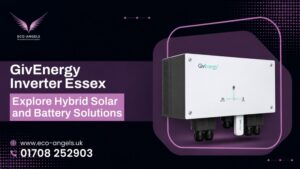
GivEnergy Inverter Essex: Explore Hybrid Solar and Battery Solutions
The inverter decides what happens to the electricity your solar panels generate, how much of the excess goes into a battery and when the house
Secure Next Day Delivery
Fully tracked consignments
Free Collection
Discover Our Free Store Collection
Trade accounts
Exclusive trade benefits
Secure Next Day Delivery
Fully tracked consignments
Free Collection
Discover Our Free Store Collection
For many businesses, the first instinct when specifying solar battery storage is to choose the largest available option. More battery capacity lets more electricity be stored for later use, which can help a business manage energy costs, but the savings depend on consumption patterns and system design, and backup power during a grid outage needs compatible equipment and a correctly configured installation. In practice, oversizing a commercial battery system is a common specification error, and it carries a real financial cost.
Capacity is only one part of the equation. A system that is too large for the building it serves will not cycle fully on most days, resulting in capital tied up in unused storage. A system that is too small will fail to capture the available generation and fall short of the savings the business was expecting. Both outcomes are avoidable, and both begin with the same oversight: treating battery sizing as secondary to brand or price.
When businesses search for the best solar battery storage in London, they often focus on kilowatt hours. That is understandable, as it is the most visible figure on any datasheet. However, capacity alone does not tell you whether a battery will work for your building.
The more useful question is how much energy the business consumes, and when. A London office with consistent daytime occupancy has a very different load profile from a restaurant that draws heavily in the evening or a retail unit with weekend peaks. A battery sized for 1 of these patterns can perform poorly in another, even if the total capacity figure looks similar on paper.
Battery capacity does not exist in isolation. Several other variables shape the right size for a commercial installation:
An oversized battery may provide more storage capacity than a business can regularly use, increasing the initial investment without delivering proportional financial benefits. Partial charging and discharging do not automatically reduce battery efficiency or lifespan. The financial impact depends on electricity consumption, charging patterns, operating conditions and how effectively the available capacity is utilised.
For London businesses already working with tight margins, this matters. Committing significant capital to a commercial solar battery in London that runs at 30 to 40 per cent of its capacity on an average day is not an efficient use of resources. The same budget, applied to a correctly sized system with well matched components, will typically deliver better results over the life of the installation.
The opposite error is equally common. A battery with insufficient capacity may reach its charging limit while the solar panels are still generating electricity. Depending on the system configuration, surplus electricity may then be exported to the grid, or generation may be limited. Although eligible businesses can receive payments for exported electricity, storing more energy for later use may offer greater financial value in some circumstances. The most suitable battery capacity depends on electricity tariffs, consumption patterns, export arrangements and overall system efficiency.
Undersizing is also harder to correct after installation. Adding capacity retrospectively is possible with some systems, particularly those using modular battery architectures, but it is not always straightforward and is rarely cheaper than specifying correctly from the outset.
A properly sized commercial solar battery starts with an energy audit. This means reviewing at least 12 months of consumption data to understand daily and seasonal patterns, identifying peak demand periods, and mapping that consumption against the expected generation profile of the proposed solar array.
London’s latitude and typical weather patterns mean the generation is uneven across the year. A system sized on summer performance will be underutilised in winter. A system sized on winter figures may not capture the full available generation during the longer days of spring and summer. A good specification accounts for both.
From there, the battery capacity, inverter size and array output need to be balanced against each other. The best solar batteries in London for commercial use are the ones correctly matched to the system and the building they serve, and that is not always the battery with the highest capacity figure.
Eco Angels supplies a wide range of commercial grade solar battery storage in London from established manufacturers including AlphaESS, Fox ESS, GivEnergy, Growatt, Hanchu ESS and Qcells. The range covers both low voltage and high voltage systems, with options suited to a wide variety of commercial load profiles and installation types. MCS certified installers can access trade pricing, dedicated account management and next day delivery through our trade account programme.
If you are specifying a solar battery in London for a commercial property and want to discuss the options available, our team is available Monday to Friday, 8:00am to 5:00pm. Call us on 01708 252903 or email in**@********ls.uk.
The best option depends on the building’s load profile, the size of the solar array and the inverter being used. There is no single answer; correct sizing and component matching matter more than brand alone.
Start with at least 12 months of consumption data. An MCS certified installer can carry out a full energy audit and produce a specification matched to your actual usage patterns.
Some battery systems are designed with modular expansion in mind, allowing extra capacity to be added as demand grows. Others are fixed at the point of installation. The distinction is not always obvious from headline specifications, so it is advisable to ask your installer directly whether the system being proposed supports future capacity additions and under what conditions.
Businesses may be able to benefit from the Smart Export Guarantee for surplus electricity exported to the grid, subject to metering and supplier conditions. Capital allowances on qualifying solar and storage equipment may also apply. Eligibility depends on individual circumstances, so a qualified tax adviser should be consulted before any financial benefit is assumed.
Eco Angels supplies commercial grade solar batteries in London and across the UK to MCS certified installers and trade buyers. Free collection is available from our Essex trade counter, and next day delivery is available on stocked items. Contact us to confirm availability and arrange delivery.
The inverter decides what happens to the electricity your solar panels generate, how much of the excess goes into a battery and when the house

For many businesses, the first instinct when specifying solar battery storage is to choose the largest available option. More battery capacity lets more electricity be