

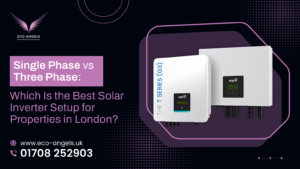
Single Phase vs Three Phase: Which Is the Best Solar Inverter Setup for Properties in London?
When choosing a solar installation for a London property, homeowners need to look beyond brand or output rating. One of the first questions any experienced
Secure Next Day Delivery
Fully tracked consignments
Free Collection
Discover Our Free Store Collection
Trade accounts
Exclusive trade benefits
Secure Next Day Delivery
Fully tracked consignments
Free Collection
Discover Our Free Store Collection
One of the most common questions asked at the start of any domestic solar project is also one of the most misunderstood. “How many panels do I need?” It seems like it should have a simple answer, but in practice, it depends on several variables and getting it wrong in either direction costs money. Too few panels and the system underperforms against expectations. Too many panels mean you have paid for capacity that your roof, inverter, or household load profile simply cannot justify.
This guide sets out the key considerations clearly and practically. Whether you are an MCS-registered installer specifying a system for a client or a homeowner researching home solar panels in Essex before making an informed decision, the following breakdown explains what the numbers typically look like — and why they differ from one property to the next.
The most reliable way to size a domestic solar system is to begin with the household’s annual electricity consumption rather than with a target panel count. Household electricity usage varies widely depending on property size, occupancy, and lifestyle. Reviewing actual annual consumption provides a more accurate starting point for solar system sizing, though this figure varies considerably depending on property size, number of occupants, and whether the home has an EV charger, electric heating, or other high-demand appliances.
The annual output of a solar panel depends on its wattage, roof orientation, location, shading, and installation conditions. A professional system designer will estimate expected generation based on the specific property. Working backwards from the household’s consumption figure gives a sensible and defensible starting point for system size, rather than a number arrived at by guesswork or generic advice.
For a home consuming the national average of 3,500 kWh annually, a system of between 10 and 14 panels delivering approximately 4kWp to 5kWp will cover a meaningful proportion of daytime electricity demand. That is a starting point, not a fixed rule. It gets refined by the site-specific variables below.
A south-facing roof at a 30 to 35 degree pitch produces the maximum annual yield in the UK. East or west-facing roofs generate roughly 15 to 20 per cent less over the course of a year. North-facing roofs generally produce lower yields than south, east, or west-facing roofs, but they may still be considered where the overall system design makes sense. Where a roof faces anything other than due south, the panel count typically needs adjusting upward to compensate for the reduced generation.
Solar irradiance varies meaningfully across the UK. Properties in the south of England — including those requiring domestic solar panels in Essex — benefit from slightly higher annual irradiance figures than those in the north of England or Scotland. This geographic advantage, while not dramatic, contributes to system efficiency and should be reflected in yield calculations.
Even partial shading from a chimney stack, a neighbouring tree, a dormer window or a satellite dish can significantly reduce output from an unoptimised string system. Where shading is present, power optimisers or a microinverter configuration should be considered alongside the panel count to mitigate the impact on overall yield.
A standard 400W domestic panel measures approximately 1.7 metres by 1.1 metres. A 12-panel system occupies roughly 22 square metres of usable roof area. Available space is often the binding constraint on smaller properties, while on larger detached homes it is usually the inverter capacity or budget that sets the upper limit.
A family of four with an EV charger and an air source heat pump has a fundamentally different load profile to a retired couple in a two-bedroom semi. The system should be sized to actual consumption patterns and anticipated future demand, not a national average applied without context.
While every installation is different, the following framework provides a useful working reference for solar panels in Essex and across the broader UK market:
These figures assume standard 400W panels on a south-facing roof at approximately 35 degrees with no significant shading. They should be treated as a starting framework rather than a finished specification and adjusted accordingly following each site survey.
Panel count alone does not define system performance. The inverter and solar array should be correctly matched. Some systems allow a degree of array oversizing, but this should be carefully designed to balance performance and potential clipping. A clipping loss of even five to ten per cent across the summer months represents a meaningful reduction in annual yield.
If battery storage is part of the brief, the battery capacity should be sized to absorb the system’s daily surplus generation rather than being selected independently of the panel count and inverter specification. A well-matched system — panels, inverter and battery working together — will consistently outperform a system where each component has been chosen in isolation.
Eco Angels supplies solar equipment to installers and trade customers, including MCS-registered professionals. Our current panel range includes high-efficiency N-type bifacial modules from leading manufacturers. Available products can be delivered through tracked delivery options or collected from the Essex trade counter, subject to availability.
Alongside our solar panel range, we stock hybrid inverters, string inverters, battery storage systems, power optimisers, DC cables, mounting systems for pitched, flat, corrugated, and slate roofs, and a comprehensive range of solar accessories and safety signage. Eco Angels supports installers with trade account options, product availability, delivery services, and technical support.
Browse the full solar panel range online or contact our trade team to discuss your next domestic installation.
Most UK homes are well served by a system of 10 to 14 panels delivering 4kWp to 5kWp, though the correct number depends on annual energy consumption, roof orientation, available space and future demand.
Yes. Eco Angels stocks a range of domestic solar panels in Essex with next-day tracked delivery available on in-stock items. Free collection from our Aveley, Essex, trade counter is also available.
Yes. South-facing roofs produce the highest annual yield in the UK. East or west-facing roofs generate roughly 15 to 20 per cent less, which typically means specifying additional panels to achieve an equivalent output.
Oversizing modestly to account for anticipated future demand, such as EV charging or battery storage, is generally sensible. However, the inverter must be sized accordingly to avoid clipping losses that reduce yield on high-irradiance days.
Yes. Eco Angels supplies MCS-registered installers and trade buyers with home solar panels in Essex and nationwide. Trade account benefits include discounts of up to 20 per cent, dedicated account managers, and credit accounts available on application.
When choosing a solar installation for a London property, homeowners need to look beyond brand or output rating. One of the first questions any experienced
Rising electricity costs and growing interest in reducing household carbon emissions have encouraged more homeowners to consider home solar panels in London. From Victorian terraces